From our previous website’s article collection. Dates, prices and treatment information reflect the original publication period.
Quick Answer: Polymorphic light eruption (PMLE) is a delayed hypersensitivity reaction characterized by itchy papules and vesicles appearing 24–72 hours after UV exposure. It is not a true IgE-mediated allergy but rather a T-lymphocyte-mediated immune response. Affecting 10–15% of the population, it is the most common form of sun sensitivity. A "hardening" phenomenon can develop with repeated sun exposure over time. Acute treatment includes topical steroids and antihistamines, while prevention relies on broad-spectrum SPF and a dermatologist-supervised hardening protocol.The majority of patients who say "I have a sun allergy" are actually experiencing polymorphic light eruption (PMLE). This condition differs from a true allergic mechanism, yet it is extremely uncomfortable and affects quality of life. In regions where summer sun intensity is high, PMLE complaints increase significantly during spring and summer. This comprehensive guide covers everything from the definition of PMLE to its differential diagnosis and hardening protocol.
What Is PMLE? Is It a True Allergy?
Polymorphic light eruption is technically not an allergy but a delayed-type (type IV) hypersensitivity reaction. Unlike IgE-mediated anaphylactic mechanisms, T-lymphocytes and dendritic cells play a role in this reaction. UV exposure alters skin antigens, causing the immune system to respond abnormally to those antigens.
Prevalence studies show that PMLE occurs in 10–15% of the general population. It is three times more common in women than men. It typically begins between ages 20–40 and flares in early spring — when skin has not adapted to sunlight after a long winter.
PMLE, Sunburn and Photosensitivity: Differential Diagnosis Table
| Feature | PMLE | Sunburn | Chemical Photosensitivity |
|---|---|---|---|
| Onset time | 24–72 hours after UV exposure | 2–6 hours after UV exposure | 24–72 hours after first exposure |
| Primary lesion | Itchy papules, vesicles, plaques | Erythema, painful burning | Erythema, edema, bullae |
| UV spectrum involved | UV-A (passes through glass!), rarely UV-B | Primarily UV-B | UV-A (drug/cream interaction) |
| Itching | Prominent — typical finding | Mild / burning sensation | Variable |
| Effect of repeated exposure | May decrease (hardening) | Similar each time | Resolves when agent is stopped |
| Skin type association | More common in Fitzpatrick I–III | All skin types | Independent of skin type |
Clinical Features of PMLE and Why It Is Called "Polymorphic"
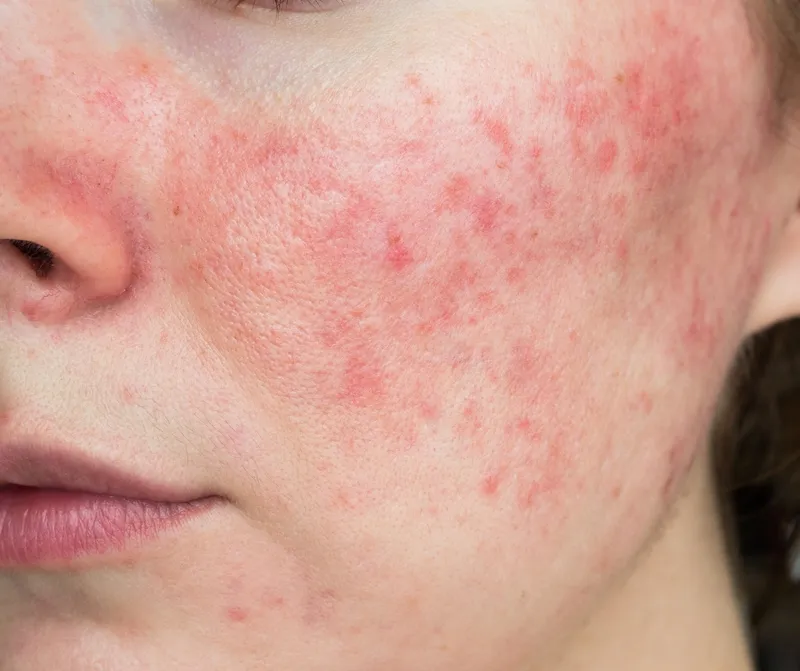
The term "polymorphic" indicates that lesions do not appear in a single morphology. Papules, vesicles, edematous plaques, or erythematous surfaces may coexist in the same patient. Lesion morphology can vary from person to person, but the same individual usually shows a consistent pattern (personal phenotype).
PMLE lesions appear on sun-exposed areas that are otherwise protected from sunburn: the décolletage, outer arms, and dorsal hands. The face may be less affected because facial skin has greater tolerance due to chronic sun exposure (natural hardening).
UV-A and Glass: Why Can It Occur Even Inside a Car?
An important feature of PMLE is its sensitivity to the UV-A spectrum. UV-A (320–400 nm) can penetrate glass and plastic; therefore, sitting near a car window, light coming through office glass, and even skin exposure on cloudy days can trigger PMLE. Standard glass filters UV-B but does not block UV-A. This explains the complaint of "I didn't go outside but I got a rash."
Triggers and Aggravating Factors
- Early spring onset: Skin that has not adapted during winter is most sensitive. Days when a person is exposed to prolonged sun for the first time are the highest-risk periods for PMLE.
- Holiday travel: Intense UV increase in those traveling from continental climates to sunny regions is a trigger. The difference in UV index between temperate cities and southern holiday destinations is significant.
- Certain medications: Photosensitizing drugs (tetracyclines, thiazides, NSAIDs) can produce PMLE-like presentations or worsen existing PMLE.
- Hormonal changes: Oral contraceptive use can trigger PMLE in some patients.
Acute Phase Treatment
Treatments during a PMLE flare are symptomatic in nature:
- Topical corticosteroid: A moderate-strength steroid cream (e.g., 0.1% betamethasone) rapidly reduces itching and inflammation. Milder preparations (e.g., 1% hydrocortisone) are more appropriate for facial areas.
- Oral antihistamine: Sedating antihistamines (e.g., chlorphenamine, hydroxyzine) are recommended as evening doses for itch control.
- Cold compress: Applying a wet gauze pad for 10–15 minutes provides temporary relief from edema and itching.
- Avoiding sun exposure: Stopping UV exposure during the acute phase halts the spread of lesions; spontaneous regression begins within a few days.
- In severe cases: A short course of oral corticosteroids (5–7 day course) may be considered under dermatological supervision.
The Hardening Phenomenon in PMLE
An interesting feature of PMLE is that immune tolerance increases with repeated UV exposure and eruptions diminish over the summer. This phenomenon is called "hardening." PMLE that begins with increasing sun exposure in spring gradually decreases with regular and incremental UV exposure, as the immune system begins to develop tolerance through gradual stimulation.
A clinically controlled hardening protocol can be applied:
- Narrowband UVB phototherapy under dermatological supervision (3 times/week, 6–8 weeks)
- PUVA (psoralen + UV-A) combination therapy — for severe cases
- Natural hardening: gradual and controlled sun exposure, increasing duration each day
Hardening should only be performed under dermatologist supervision; uncontrolled sun exposure may worsen PMLE or increase the risk of photocarcinogenesis.
Protection and Prevention Strategies
- Broad-spectrum SPF 50+ sunscreen: Must contain UV-A protection (labeled PA++++ or UVA-PF 16+). Standard SPF value reflects only UV-B protection; check the product label for UV-A protection.
- Protective clothing: UPF 50+ garments, hats, and sunglasses support physical barriers.
- Sun exposure timing: The UV index is highest between 10:00 a.m. and 4:00 p.m.; direct sun exposure should be limited during these hours when possible.
- Nicotinamide (vitamin B3) supplementation: Some studies suggest oral nicotinamide may reduce UV-induced immune suppression; supplementary use may be considered with dermatological guidance.
Fitzpatrick Skin Type and PMLE
PMLE is most common in Fitzpatrick type I and II (very fair, easy to burn) skin types. It can also occur in type III (light tan, mildly burns). Although PMLE is rarer in types IV–VI (darker skin), these skin types can present with sun sensitivity in different forms (e.g., actinic prurigo). Skin type classification is decisive in selecting treatment protocols and making protective recommendations.
When Should You See a Dermatologist?
Dermatological evaluation is recommended in the following situations:
- When eruptions appear for the first time (to rule out photodermatoses other than PMLE)
- If eruptions occur in the shade or without sun exposure (suspicion of systemic photosensitivity)
- If there is a possibility of co-existing autoimmune disease such as lupus erythematosus
- If acute flares recur frequently and seriously affect quality of life (for a hardening protocol)
PMLE Assessment at Abel Beauty
Patients presenting to Abel Beauty with sun allergy complaints first undergo a detailed history-taking and clinical evaluation. Lesion morphology, UV spectrum sensitivity, and triggering factors are identified. Patients diagnosed with PMLE receive an individualized protection protocol; hardening therapy is planned where appropriate. Please contact us for a consultation and pricing information.
Frequently Asked Questions
I say I have a sun allergy and I do wear sunscreen, but I still get reactions — why? The UV-A protection in your sunscreen may be insufficient. PMLE is particularly sensitive to UV-A; products with PA++ or lower UV-A protection may not be adequate. Check the "broad spectrum" label and the PA rating on the product.
Is PMLE contagious? No, it is definitely not contagious. It is an immunological reaction; there is no possibility of transmission to others.
Can children develop PMLE? Yes, it can occur before and after puberty. A dermatological evaluation is recommended if a child has sun sensitivity complaints.
This article is for informational purposes only. Please consult a qualified physician for treatment decisions.