From our previous website’s article collection. Dates, prices and treatment information reflect the original publication period.
⚡ Quick AnswerDuring the first 48 hours after thread lifting, avoid touching your face and sleeping face-down; makeup should be deferred for at least 48 hours. Swelling recedes in 3–5 days and bruising in 5–10 days. Thread visibility, significant asymmetry, or increasing pain are reasons to contact the clinic promptly.
Why Is Aftercare So Important After Thread Lifting?
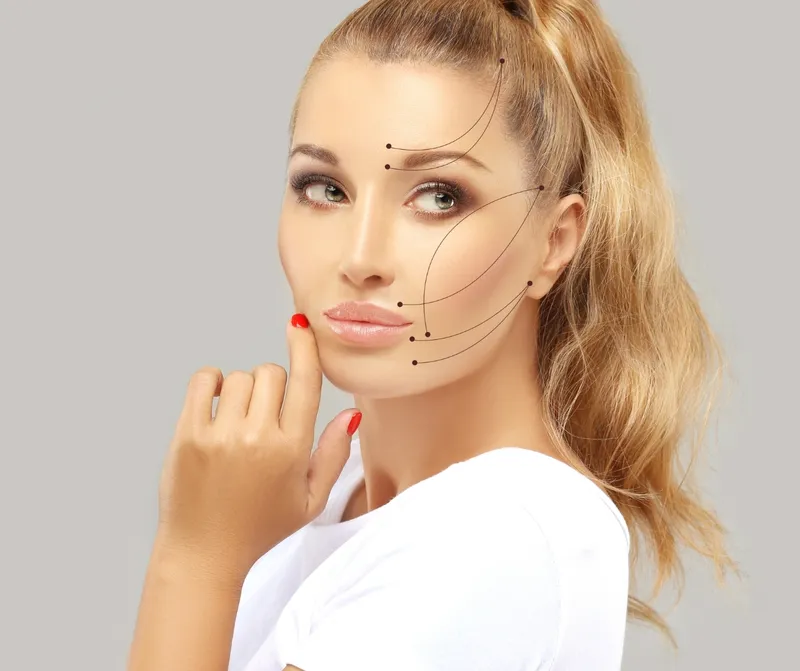
Thread lifting (PDO thread lift) is a non-surgical facial lifting and tightening procedure performed with polydioxanone or PLLA/PCL threads. The success of the procedure is directly related not only to technical quality, but also to care compliance during the critical first 2 weeks following the procedure.
After threads are placed under the skin, they act through two mechanisms:
- Mechanical lifting: With barbed (COG) threads, an immediately visible tightening and lifting effect occurs.
- Biostimulation: The threads are absorbed by the body within 6–12 months; throughout the dissolution process, fibroblasts are stimulated and new collagen is synthesized. This effect becomes noticeable within 3–6 months and lasts for 12–18 months.
For both mechanisms, it is critical that the thread remains in the correct position. Incorrect sleep position, early massage, or excessive pressure on the face can cause thread displacement and compromise the result.
First 48 Hours: What Should Be Avoided?
The first 48 hours is the period in which the tissue layer where the thread has been placed is most sensitive. Things to strictly avoid:
- Touching and rubbing the face: The thread under the skin is still in the process of anchoring; any pressure applied from outside can displace it.
- Sleeping face-down or on the side: Pillow pressure can cause thread displacement, especially in threads near the hairline area. Sleep on your back with your head slightly elevated.
- Intense exercise and heavy sport: The increase in blood pressure and body temperature prolongs swelling and bruising duration.
- Sauna, hammam, and hot shower: High heat dilates blood vessels; in this early period, it increases the risk of edema and bleeding.
- Alcohol consumption: Alcohol has a vasodilatory effect; it can intensify bruising and swelling.
- Applying makeup: Entry points may remain open for the first 24–48 hours; during this time, makeup creates a gateway for infection.
Why Is Sleep Position Important After Thread Lifting?
Sleep position after thread lifting is one of the most neglected topics; however, its effect on result quality should not be underestimated. The recommended approach:
- Sleep on your back for the first 2 weeks, with the head slightly elevated (a second pillow or a wedge pillow)
- If you must sleep on your side, apply as little pressure as possible with the softest possible pillow
- If a prominent mark remains on one side of the face in the morning, the sleep position needs to be changed
Using an elevated pillow is advantageous both for edema control (gravitational drainage) and for reducing pressure on the face.
When Do Swelling and Bruising Subside?
| Symptom | Expected Duration | Management |
|---|---|---|
| Mild–moderate swelling | 2–5 days | Cold compress (over a thin cloth), keep head elevated |
| Bruising | 5–10 days | Arnica gel (with physician approval), concealer makeup from hour 48 |
| Tenderness and pain | 3–7 days | Paracetamol (use NSAIDs with caution as they can increase bruising) |
| Entry point crusting | 3–5 days | Do not pick off; clean with antiseptic lotion |
| Entry point scar risk | After healing | Use SPF and do not apply pressure to the area |
When Can Makeup Be Applied?
The definitive limit is 48 hours. Some clinicians permit it after 24 hours when entry points are fully closed, but the general consensus points to 48 hours. Depending on the extent of the procedure and the number of threads, some patients are advised to wait 72 hours.
Points to consider when applying makeup:
- Prefer light, fragrance-free, non-heavy products
- Avoid heavy rubbing or brush pressure in the first week
- Do not apply products directly to entry points until they are fully closed
- Makeup removal should be done gently, without rubbing
When Can Facial Massage Be Done After Thread Lifting?
Facial massage should be deferred for at least 4–6 weeks after thread lifting. Particularly in procedures performed with COG (barbed) threads, facial massage must absolutely not be done before this period has elapsed. Mechanical force can disrupt the fibrous capsule to which the thread is anchored and eliminate the lifting effect.
Lymphatic drainage massage, however, can be planned from weeks 2–3 onwards with an expert physiotherapist and with physician approval; it should not be thought of in the same way as a classical facial massage.
Complication Warning Signs: When to Contact the Clinic
In the following situations, contact Abel Beauty Izmit or the clinic that performed the procedure without delay:
- Significant asymmetry: If one side appears to have lifted or pulled much more than the other
- Thread visibility (visible thread): If a thread line is visible or palpable under the skin
- Increasing pain: If it is increasing rather than decreasing after day 3
- Signs of infection: Redness, warmth, discharge, fever
- Loss of facial expression or changes in sensation: If transient numbness is noticed in areas near nerve branches
- Deep hollowing or irregularity: Surface irregularities that have not resolved after 2 weeks
Most of these signs can be corrected with early intervention; delayed treatment can negatively affect outcomes.
When Can Skincare and Other Procedures Be Done?
- Gentle cleanser and moisturizer: From hour 48
- SPF use: From hour 48 (mandatory)
- Active skincare products (retinol, AHA, vitamin C): Gradual introduction after 1 week
- Clinical facial treatment: Wait at least 3–4 weeks
- Laser, RF or high-energy devices: Wait at least 4–6 weeks
- Botox or filler: After 4 weeks, with physician evaluation
Recommendations for Long-Term Results
To increase the longevity of thread lift results:
- Sun protection: UV exposure accelerates collagen degradation; SPF 30+ should be used every day.
- Skin hydration: Well-hydrated skin preserves the collagen network better.
- Retinol home care: Retinol used with dermatologist approval supports collagen synthesis.
- Quitting smoking: Smoking significantly impairs skin oxygenation, seriously hindering the collagen formation created by the thread.
- Regular follow-up sessions: 1–2 maintenance sessions per year keep collagen stimulation active.
- Nutrition: A diet rich in vitamin C, zinc, and protein supports collagen biosynthesis.
How Long Do PDO Thread Lift Results Last?
The longevity of results varies depending on thread type, number of threads used in the procedure, and individual metabolism:
- Mechanical lifting effect: 6–12 months
- Biostimulation (collagen) effect: 12–18 months
- With PLLA / PCL threads: Can extend to 18–24 months
At Abel Beauty Izmit, two follow-up appointments — at week 2 and month 3 — are part of our standard post-procedure protocol. Please contact us for pricing information.
Frequently Asked Questions
When can I sleep face-down after a thread lift?
The general recommendation is to sleep on your back for at least 2 weeks. After the 2nd week, you can carefully begin sleeping on your side; sleeping face-down should be postponed for at least 3–4 weeks.
Chewing feels difficult after the procedure — is that normal?
Yes, this is very common. Threads in the temporal and neck areas can create a feeling of tension with chewing movements. This feeling usually passes within 1–2 weeks. It is recommended to avoid very hard foods during this period.
I can feel the thread under my skin — is that normal?
Feeling the thread under the skin or having mild touch sensitivity for 2–4 weeks after the procedure is normal. If there is a protrusion visible or palpable from the skin surface, you should contact the clinic.
Can thread lift and filler be done on the same day?
It is theoretically possible, but separate sessions are generally preferred. Leaving at least 2–4 weeks between the two procedures facilitates healing and makes evaluation clearer.
Does thread lift leave scars?
The micro entry points close within 3–5 days and generally leave no marks. Not touching the entry points, not picking off crusts, and using SPF minimize the risk of scarring.
When will results be fully visible?
The mechanical lifting effect is visible immediately; the skin quality improvement created by collagen formation becomes noticeable within 3–6 months. Therefore, full evaluation should be done no earlier than month 3.
This article is for informational purposes only. Please consult a qualified physician for treatment decisions.