From our previous website’s article collection. Dates, prices and treatment information reflect the original publication period.
Quick Answer: The decline in oestrogen levels during menopause reduces skin collagen by approximately 30% within the first five years, resulting in dryness, sagging, wrinkles and pigmentation changes. Medical aesthetic interventions (Profhilo, PLLA biostimulators, RF microneedling, HIFU, HA fillers) have proven efficacy in physiologically slowing this process. Results are strengthened when combined with hormone replacement therapy (HRT). At Abel Beauty (Izmit/Kocaeli), the hormone-skin relationship is evaluated and a holistic treatment plan appropriate to each stage is prepared.Menopause and Skin: The Biological Role of Hormones
Menopause is a physiological process defined by the absence of menstruation for 12 consecutive months, resulting from the depletion of ovarian follicles. The average age of menopause in Turkey is between 47 and 51; perimenopause (the transitional period) may begin 2–10 years earlier. During this process, the production of oestrogen, progesterone, and androgens declines markedly. Hormonal loss is not confined to the reproductive system; it directly affects many tissues including the skin, hair, bones, cardiovascular system, and central nervous system.
Oestrogen receptors (ER-alpha and ER-beta) in the skin are distributed widely in the epidermis, dermis, and hair follicles. Through these receptors, oestrogen regulates collagen synthesis, skin hydration, epidermal thickness, wound healing, and melanocyte activity. As a result, declining oestrogen leads to rapid and multidimensional changes in the skin; some of these changes mimic or accelerate chronological ageing.
Collagen Loss: The Most Pronounced and Fastest Effect of Menopause on the Skin
Clinical studies have shown that skin collagen content declines by approximately 30% in the first five years of menopause. A steady loss of 2.1% per year continues thereafter — more than double the 1% annual loss seen in the premenopausal period. This loss encompasses both Type I collagen (structural support) and Type III collagen (elasticity).
| Stage | Cumulative Collagen Loss | Notable Skin Changes | Medical Aesthetic Priority |
|---|---|---|---|
| Perimenopause (ages 40–50) | 5–10% | Onset of dryness, fine lines | Profhilo, HA mesotherapy |
| Early menopause (first 5 years) | 25–30% | Pronounced sagging, deep wrinkles | PLLA biostimulator, HIFU, RF |
| Late menopause (5–15+ years) | 40–50% | Atrophy, thin skin, visible capillaries | Comprehensive combination programme |
Key Skin Changes During Menopause: A Comprehensive Overview
The effects of oestrogen deficiency on the skin create a self-reinforcing cycle:
- Dryness and barrier disruption: Oestrogen supports skin lipid synthesis and ceramide production; its decline increases transepidermal water loss (TEWL). The skin becomes dry, itchy, and increasingly sensitive.
- Atrophy (thinning): Dermal thickness decreases; as the epidermis thins, the capillary network may become visible. Thin skin becomes more susceptible to trauma.
- Sagging and ptosis: With the loss of collagen and elastin, retaining ligaments loosen; pronounced sagging develops in the face, neck, and décolletage.
- Increased wrinkling: Dynamic (movement-related) wrinkles become static; they deepen in the periorbital, perioral, and forehead regions.
- Pigmentation irregularities: Solar lentigines and melasma-like hyperpigmented patches increase; hypopigmentation may also occur in some areas.
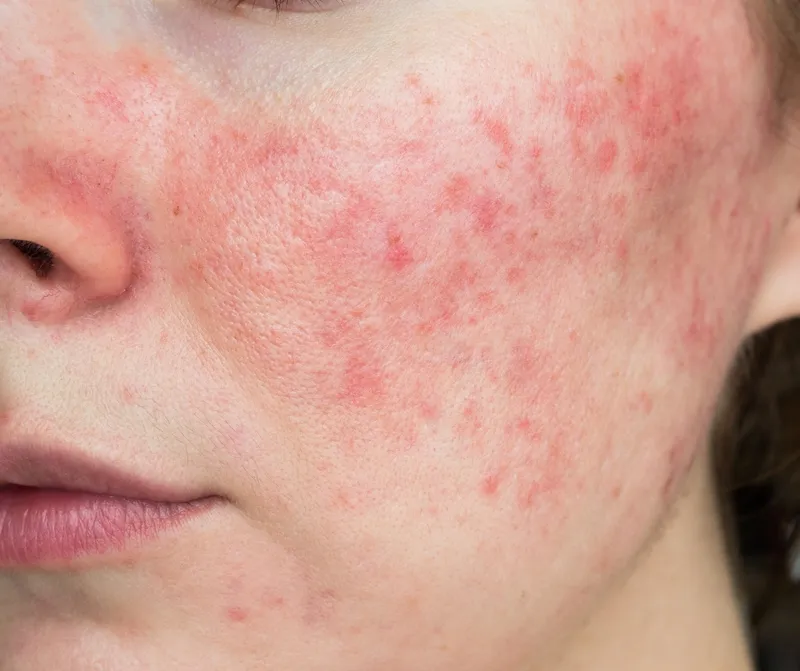
- Hot flushes and facial flushing: Vasomotor symptoms cause transient erythema; a rosacea-like picture may be triggered.
- Signs of androgenisation: As the oestrogen/androgen balance shifts towards androgens, fine facial hair (facial hirsutism) and acne-like lesions may appear.
- Impaired wound healing: With the reduction in oestrogen's anti-inflammatory regulatory role, skin injuries take longer to heal.
The Oestrogen-Collagen Axis: Summary of Scientific Evidence
It has been established through both in vitro studies and randomised clinical trials that oestrogen stimulates dermal fibroblasts to increase Type I and Type III collagen synthesis. Key findings can be summarised as follows:
| Effect | Mechanism | Clinical Significance |
|---|---|---|
| Increased collagen synthesis | Fibroblast TGF-beta signal activation | Preservation of skin thickness and elasticity |
| Inhibition of collagen degradation | Suppression of MMP-1, MMP-3 | Protection of the dermal matrix |
| Improved skin hydration | Stimulation of HA and ceramide synthesis | Barrier function and moisture retention |
| Accelerated wound healing | Keratinocyte and fibroblast proliferation | Faster epithelialisation |
Evidence-Based Skincare Routine During Menopause
In post-menopausal skincare, the order of priorities is: (1) Barrier repair, (2) Intensive hydration, (3) Antioxidant and collagen support, (4) Sun protection.
- Cleansing: Gentle, creamy cleansers free of SLS/SLES with a pH of 4.5–5.5; alcohol-containing toners and harsh foaming products should be avoided.
- Moisturisation: "Barrier repair" creams containing a combination of hyaluronic acid (multi-molecular weight) + ceramides + cholesterol + niacinamide should be applied morning and evening.
- Retinoids: Tretinoin (0.025–0.05%) or adapalene is the most evidence-based topical remodelling agent for fibroblast activation and collagen synthesis; should be introduced gradually.
- Vitamin C (L-ascorbic acid 10–20%): Reduces UV-induced damage through antioxidant action; acts as a prolidase cofactor for collagen synthesis. Applied in the morning.
- Peptides: Biomimetic matrix peptides such as palmitoyl tripeptide-1 and Argireline may be added for wrinkles and sagging.
- Sunscreen: Mineral SPF 50+ is essential every morning; it prevents pigmentation disorders and slows collagen degradation.
Medical Aesthetic Treatment Options: Problem-Solution Overview
| Problem | Recommended Treatment | Mechanism of Action | Duration of Effect |
|---|---|---|---|
| Dryness, skin atrophy | Profhilo, HA mesotherapy | Deep hydration, biostimulation | 6–12 months |
| Collagen loss, thinning | PLLA (Sculptra), CaHA biostimulator | Collagen neo-synthesis | 18–24 months |
| Facial/neck sagging | HIFU, monopolar RF, PDO thread lift | SMAS tightening, neo-collagenesis | 12–18 months |
| Deep dynamic wrinkles | Botulinum toxin (BTX-A) | Muscle relaxation, dynamic line reduction | 3–4 months |
| Static deep lines, volume loss | HA filler | Volume restoration, skin support | 12–18 months |
| Pigmentation, solar lentigines | Chemical peeling, picosecond laser, topical brighteners | Melanin reduction, increased turnover | Variable; maintenance essential |
| Skin texture, pores | RF microneedling (Morpheus8, Fractora) | Dermal collagen remodelling | 12–18 months (3 sessions) |
Profhilo: The Primary Biostimulator for Menopausal Skin
Profhilo is a CE-marked product combining high-molecular-weight (H-HA: 1100 kDa) and low-molecular-weight (L-HA: 23 kDa) hyaluronic acid through thermal stabilisation — it is neither a filler nor a standard mesotherapy product. Applied at 5 BAP points (Bio Aesthetic Points) for the face and according to specific protocols for the neck, Profhilo significantly stimulates the synthesis of collagen Types I–IV and elastin in vitro while intensely hydrating the skin. It has become widely used as a "starter treatment" for the common complaints of dryness and atrophy during menopause. Protocol: 2 sessions 4 weeks apart; repeat twice yearly is recommended.
HIFU and Radiofrequency: Non-Surgical Tightening Technologies
The most effective non-surgical methods for the facial, neck, and décolletage sagging that becomes more pronounced during menopause include:
- HIFU (High-Intensity Focused Ultrasound): Devices such as Ultraformer III and Ultherapy create focused thermal injury points from the dermis down to the SMAS layer (4.5 mm depth). Neo-collagenesis develops within 2–3 months; a single session provides 12–18 months of effect. Annual repetition is ideal during menopause.
- Monopolar radiofrequency: Homogeneous dermal heating causes instant collagen denaturation and fibroblast activation. A protocol of 3–5 sessions (at 4–6 week intervals) followed by 6–12 monthly maintenance sessions is recommended.
- RF Microneedling (Fractora, Morpheus8): Isolated radiofrequency energy is delivered through dermal needle channels, triggering remodelling in the dermis and superficial SMAS. It is considered the gold-standard combination for facial rejuvenation and sagging.
Hormone Replacement Therapy (HRT) and Skin: Synergies and Limitations
HRT is the most direct biological approach to managing menopausal symptoms and skin changes. Randomised controlled trials have shown that systemic or topical oestrogen application significantly increases skin collagen by 6.5%, as well as dermal thickness and hydration (Brincat et al., 2005). Post-menopausal skin ageing markers are significantly better in women receiving HRT compared with those who do not.
Nevertheless, the decision to initiate HRT should be made exclusively by a specialist physician (gynaecologist/obstetrician), taking into account the individual risk profile (history of breast cancer, thromboembolic disease, cardiovascular disease) and gynaecological and hormonal history. Medical aesthetic treatments can be applied effectively in both groups — those receiving HRT and those who cannot — and play a complementary role.
Common Misconceptions: There Is No Such Thing as "It No Longer Matters"
Many patients believe they have started skincare too late during menopause, or they neglect their skin with the thought of "does it make a difference at my age?" This view is not consistent with scientific reality. Skin fibroblasts can be stimulated at any age; collagen synthesis never falls to zero. Studies exist showing that even in the tenth year after menopause, significant skin thickening can be achieved with RF microneedling and biostimulator treatments. With the right protocols, stabilising facial sagging, markedly reducing wrinkles, and improving tissue quality in the 50–65 age group are realistic and attainable goals.
Menopause Skin Programme at Abel Beauty
Abel Beauty (Izmit/Kocaeli) offers a holistic, phase-based assessment for patients wishing to address skin changes during menopause. At the initial consultation, skin tone, dermal thickness, degree of sagging, and pigmentation status are systematically evaluated; a baseline is established with photographic records and measurements. A personalised medical aesthetic programme is prepared according to the menopausal stage, the predominant concerns, and the patient's expectations. For patients receiving HRT, programmes are coordinated with the gynaecology specialist. All treatment options are discussed transparently with the patient; priority steps are determined with cost-effectiveness in mind.
This article is for informational purposes only. Please consult a qualified physician for treatment decisions.