From our previous website’s article collection. Dates, prices and treatment information reflect the original publication period.
Quick Answer: The golden rule of male aesthetics is to "look better and more rested" while preserving masculine features. Unlike female aesthetics, men should retain a strong jawline, prominent cheekbones, and a square forehead; Botox doses should be lower and fillers applied with less volume. The most common signs of an overdone result are a frozen facial expression and excessive puffiness.The number of men visiting medical aesthetics clinics has risen sharply in recent years. However, the most critical challenge for this group is the expectation gap between the desired and the achieved outcome. Male patients most often want "not a dramatic change, but a better version of themselves" — yet standard protocols at some clinics result in overtreatment. This guide presents the male aesthetics principles adopted at Abel Beauty's practice in Izmit / Kocaeli in a comprehensive manner.
Why Is Male Facial Aesthetics Different from Female?
The gender distinction in facial aesthetics is not merely cultural — it has anatomical and biological foundations. Preserving the key masculine features of the male face must be the physician's primary clinical objective.
- Strong, square jawline: In men, the gonial angle (the angle of the mandible) should be more prominent and acute. Procedures that soften this structure compromise masculinity.
- Prominent cheekbones: Men have less cheek fullness and more forward-projecting cheekbones. Large cheek filler volumes, as used in female aesthetics, feminize the masculine appearance.
- Square forehead: The male forehead is flatter and more horizontal, whereas the female forehead is rounder and more inclined. If this distinction is not considered in forehead Botox, the male forehead can take on a feminine appearance.
- Chin-neck angle: A strong mandibular profile is the most defining feature of the male silhouette.
- Flat brow: The male brow should sit in a horizontal/flat position. An arched brow is an archetypal female feature; if this is not taken into account in male Botox, unwanted results occur.
What Is the Male Patient's True Goal?
The standard question asked of male patients at their first consultation at Abel Beauty is: "How do you want to look after the procedure?" The vast majority of answers cluster around these themes:
- "I don't want to look tired."
- "I want to look younger than my age, but still like myself."
- "I want to make a more dynamic impression in my professional life."
- "I want to change without my partner noticing."
When these requests are carefully analyzed, it becomes clear that the male patient wants "restoration," not a "dramatic transformation." The goal is a better version of their former self. When this distinction is not observed, the result is an overdone appearance and patient dissatisfaction.
Overdone Male Aesthetics: Signs and Avoidance Techniques
In clinical practice, the characteristic signs of "overdone" male aesthetics are:
- Frozen / plastic facial expression: The complete cessation of frontal muscle movement due to excessive Botox is the most common complaint. Forehead Botox in men should be planned with a 50–60% dose reduction.
- Puffed-up cheek appearance: When cheek filler volumes used in female protocols are applied to men, the face looks oval and feminine.
- Overly tight skin: Aggressive lift procedures distort facial expression; even minimal laxity is preferable for men in terms of natural appearance.
- Disrupted asymmetry: Minimal asymmetry in the male face is part of masculinity. Approaches targeting "perfect symmetry" eliminate naturalness.
Avoidance techniques: Less product — a multi-session strategy with small volume additions at each session; conservative dosing — Botox dose 30–50% lower in men; anatomical targeting — selecting injection points that preserve masculine contours.
The Impact of Social Media on Male Aesthetics
The proliferation of Instagram and TikTok filters has deepened the perception gap between the "digital face" and the real face. Research shows that 43% of men aged 18–35 seek aesthetic consultations influenced by filtered faces seen on social media. This phenomenon is defined in the medical literature as "Snapchat dysmorphia" or "selfie dysmorphia."
From the clinician's perspective, the physician's role is to manage unrealistic expectations formed under social media influence and to give the patient realistic outcome expectations. At Abel Beauty, expectation management with computer simulation is performed for every male patient before any procedure.
The 5 Most Popular Aesthetic Procedures for Men (Grey Area Procedures)
| Procedure | Goal | Male-Specific Dose/Technique | Duration of Result |
|---|---|---|---|
| Masseter Botox | Bruxism, facial slimming | 50–80 IU/side (high dose) | 4–6 months |
| Jawline Filler | Jawline definition | High G-prime product, supraperiosteal plane | 12–18 months |
| Laser Hair Removal | Back, neck, ear hair removal | Nd:YAG preferred, high fluence | 6–8 sessions |
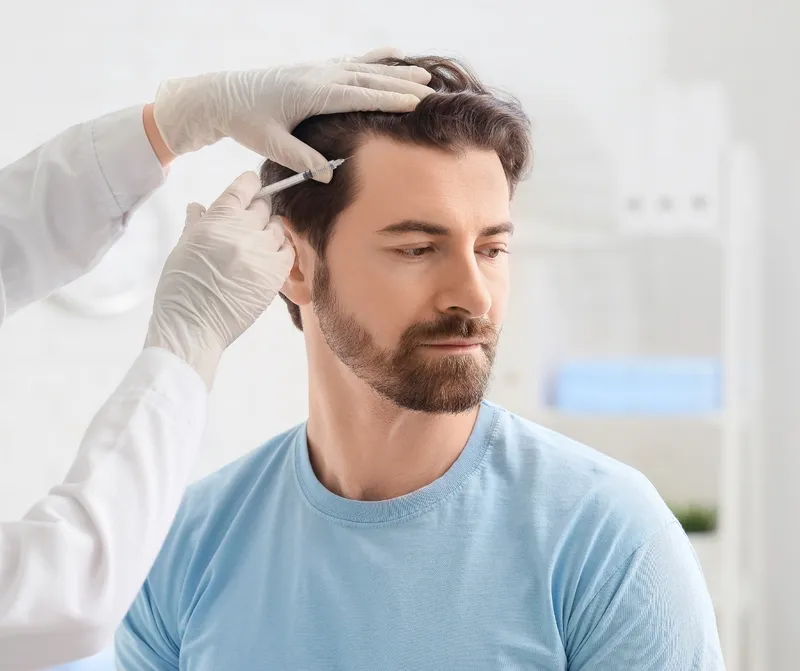
| Hair Mesotherapy | Early-stage AGA treatment | Finasteride + growth factors | 3–6 month program |
| Under-Eye Treatment | Dark circles, puffiness | Tear trough filler or PRP, low volume | 6–12 months |
Privacy and Clinical Environment Preferences
Male patients place considerably more importance on privacy in aesthetic consultations than female patients. Clinical research shows that 71% of male patients do not disclose their procedures to their social circle. This reality directly influences the design of male aesthetic services:
- Preference for a separate waiting area or private entrance
- Scheduling appointments outside regular business hours
- Keeping digital records confidential
- Delivering appointment notifications via push alerts rather than email
At Abel Beauty, the dedicated "Male Protocol" service package has been designed to meet all of these privacy expectations. Dedicated appointment slots are available at our Izmit center.
Natural Masculine Aesthetics: Criteria for Choosing the Right Physician
The most critical factor determining outcomes in male aesthetics is the choice of physician. Qualities to look for in the right physician:
- Specialized training in male anatomy
- A patient portfolio and photo archive comprising male patients
- Experience in masculine facial analysis
- A conservative approach — "less is more" principle
- Offering a pre-procedure simulation or expectation management session
Return to Social Life After Treatment
The most important practical concern for male patients is when they can return to their social and professional life after treatment. Social downtime by procedure:
| Procedure | Social Downtime | Return to Exercise |
|---|---|---|
| Botox | None (same day) | After 24 hours |
| Filler | 1–3 days (swelling) | After 48 hours |
| PRP | None (same day) | After 24 hours |
| Chemical Peel | 3–7 days (peeling) | After 7 days |
| Fractional Laser | 5–10 days | After 10 days |
2026 Trends in Male Aesthetics
Medical aesthetics industry reports on male patients summarize the standout trends for 2026 as follows:
- Masseter-jawline combination protocol: Masseter Botox and jawline filler in the same session — the fastest-growing male aesthetic procedure in Turkey.
- Hair and skin programs: Integrated programs addressing androgenetic alopecia (AGA) and facial aging simultaneously.
- Baby Botox (microbotox): Surface-level application to the forehead and crow's feet — smooth skin with full movement preserved; rapidly gaining popularity among men.
- Hyperhidrosis Botox: Underarm hyperhidrosis treatment — a growing area of demand, particularly among physically active men.
This article is for informational purposes only. Please consult a qualified physician for treatment decisions.