From our previous website’s article collection. Dates, prices and treatment information reflect the original publication period.
Quick Answer: Male-pattern hair loss (AGA — androgenetic alopecia) is caused by DHT miniaturising hair follicles. At Norwood-Hamilton Stages I–III, medical treatment (finasteride/minoxidil) combined with PRP/mesotherapy can halt progression; Stages IV–VI require hair transplantation. The earlier treatment begins, the more follicles can be preserved. The sexual side effects of finasteride are exaggerated in the media — the true incidence is only 3.8%.Approximately 50% of men experience noticeable hair loss by the age of 50, and 80% by the age of 70. Furthermore, the onset of AGA can occur as early as the twenties, and when left untreated in its early stages, hair follicles are irreversibly lost. The AGA protocol at Abel Beauty in Izmit follows evidence-based steps grounded in the 2026 current guidelines.
The Mechanism of Androgenetic Alopecia
Understanding AGA is essential for grasping why certain treatments work and others do not. The pathogenesis of the condition involves the following steps:
- Genetic predisposition: Variants in the androgen receptor gene (AR gene) cause hair follicles to be hypersensitive to DHT (dihydrotestosterone).
- 5-alpha reductase enzyme: Testosterone is converted into a more potent androgen (DHT) via the 5-alpha reductase enzyme. The type II isoenzyme is particularly concentrated in the scalp.
- DHT and follicular miniaturisation: DHT binds to androgen-sensitive follicles, shortening the growth phase (anagen) and progressively reducing follicle diameter and hair shaft diameter. Eventually the follicle begins producing vellus hairs (fine, unpigmented) and ultimately ceases production altogether.
- Points of intervention: Finasteride inhibits 5-alpha reductase; minoxidil extends the anagen phase; PRP stimulates follicular activity through growth factors.
The Norwood-Hamilton Scale: Stage-Based Assessment
The Norwood-Hamilton Scale, the standard classification system for AGA severity, is the primary tool guiding treatment decisions:
| Stage | Clinical Presentation | Recommended Treatment |
|---|---|---|
| I | Mild hairline recession | Finasteride + PRP (preventive) |
| II | Noticeable frontal hairline recession | Finasteride + Minoxidil + PRP |
| III | Frontal recession or early vertex thinning | Medical + Mesotherapy + PRP |
| IV | Bridge forming between frontal and vertex loss | Hair transplant + Medical treatment |
| V | Large loss area, thin mid-band | Hair transplant (FUE/DHI) + Medical |
| VI | Vertex and frontal regions merge into one loss area | Hair transplant (limited donor) + SMP |
| VII | Only a side and rear hair band remains | SMP (scalp micropigmentation) or hair prosthesis |
Treatment Options Efficacy Table
| Treatment | Mechanism of Action | Evidence Level | Side Effects |
|---|---|---|---|
| Finasteride (1 mg/day) | 5-AR type II inhibitor | A (FDA-approved) | Sexual (3.8% true rate) |
| Dutasteride (0.5 mg/day) | 5-AR type I+II inhibitor | B (off-label) | More than finasteride |
| Minoxidil (5% topical) | Anagen extension, vasodilator | A (FDA-approved) | Facial hair growth (rare) |
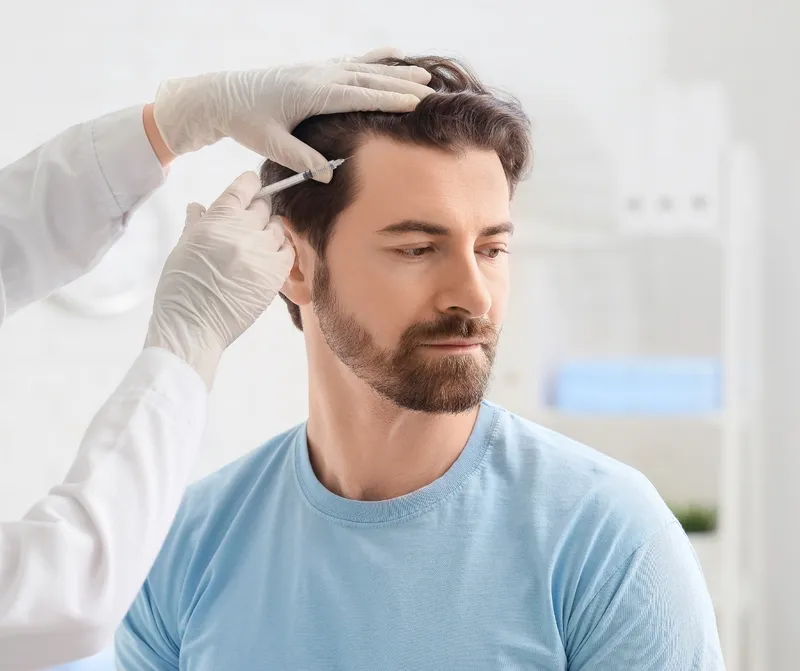
| PRP | Growth factors, follicular stimulation | B (growing evidence) | Minimal |
| Mesotherapy | Local nutrition, microcirculation | C (clinical evidence) | Minimal |
| LLLT (laser cap) | Photobiomodulation | B | None |
| Hair Transplant (FUE/DHI) | Permanent follicle transfer | A | Surgical risks |
Finasteride Sexual Side Effects: Real Rates and Media Exaggeration
While finasteride is the most effective medical agent for AGA treatment, many patients reject it due to misinformation about sexual side effects. The clinical facts are as follows:
- True rate from randomised controlled trials: All sexual side effects combined — including erectile dysfunction, ejaculatory disorder, and decreased libido — were reported at a rate of 3.8%, compared to 2.1% in the placebo group (NEJM, 2022 meta-analysis).
- Nocebo effect: Research into the "nocebo" effect has demonstrated that the expectation of side effects increases their actual incidence.
- Post-finasteride syndrome: Rarely reported persistent side effects following drug discontinuation — epidemiological evidence is extremely limited and no causal relationship has been established.
- Clinical recommendation: Before initiating finasteride therapy, detailed counselling should be provided, baseline sexual function should be documented, and patient expectations should be managed realistically.
Combined Protocol Recommendation: Treatment Plan by Norwood Stage
Recommended combined protocol for AGA management at Abel Beauty:
- Norwood I–II (Prevention phase): Finasteride 1 mg/day + 5% Minoxidil + PRP sessions every 3 months. The goal at this stage is to preserve existing follicles.
- Norwood III (Stabilisation phase): Monthly scalp mesotherapy + LLLT cap in addition to the above medical treatment. Shedding can be halted; partial density improvement is possible.
- Norwood IV–V (Restoration phase): Hair transplant + medical treatment (slows pre-transplant follicle loss and protects the donor area). PRP accelerates post-transplant recovery.
- Norwood VI–VII: Hair transplant is a limited option; scalp micropigmentation (SMP) or medical hair prosthesis may be considered.
When Should Treatment Begin?
The answer to this question is clear: the earlier, the better. Every man who notices hair loss should consult a trichology specialist within 3–6 months at the latest. The reason is this: once a follicle is fully miniaturised (no longer able to produce even vellus hairs), medical treatment can no longer rescue it — even hair transplantation is less efficient at this point because the recipient area capacity is reduced.
Trichology evaluation at Abel Beauty in Izmit includes: hair analysis by trichoscopy (follicular density, vellus/terminal hair ratio), Norwood stage determination, scalp biopsy (if indicated), systemic laboratory work-up (ferritin, thyroid, zinc, vitamin D), and a personalised treatment plan.
Abel Beauty AGA Protocol: Izmit and Kocaeli
At Abel Beauty in Izmit, hair loss treatment is approached in a multidisciplinary manner. Each patient receives a trichology examination, trichoscopy analysis, and a personalised 6-month treatment plan. Only the patient's own blood is used in clinic PRP sessions, and FDA-approved ingredients are preferred for scalp mesotherapy.
This article is for informational purposes only. Please consult a qualified physician for treatment decisions.