From our previous website’s article collection. Dates, prices and treatment information reflect the original publication period.
Quick Answer: Under-eye mesotherapy is a gradually effective treatment in which mixtures of active substances are injected into the under-eye area with fine needles. A hemodetox cocktail is used for vascular dark circles, while HA + vitamin C + peptide formulations are used for skin quality. An initial protocol of 4–6 sessions is recommended; it complements the immediate effect of tear trough filler but cannot replace it.What Is Under-Eye Mesotherapy and When Is It Preferred?
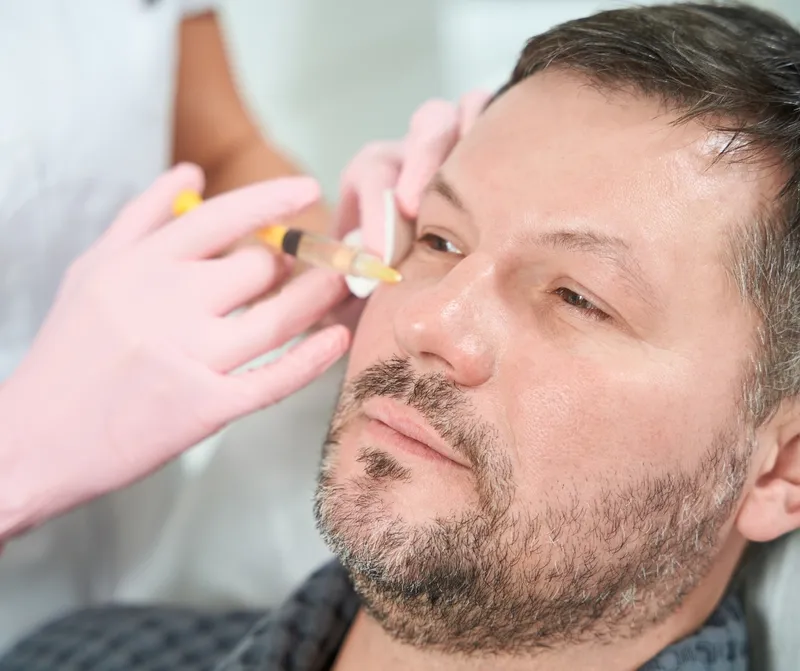
Under-eye mesotherapy is a minimally invasive procedure in which active substances are delivered directly to the lower eyelid skin using micro-needles or the nappage technique. Unlike conventional filler treatment (volume addition), the goal of mesotherapy is to improve skin quality, reduce vascular dark circles, and enhance overall hydration and luminosity in the area.
At Abel Beauty, under-eye mesotherapy is recommended for two distinct patient profiles:
- Preparation for tear trough filler: In patients with insufficient skin thickness, 2–3 sessions of mesotherapy improve skin quality prior to filler placement.
- Standalone treatment: When structural hollowing is minimal and the dark circles are predominantly vascular or related to skin quality, mesotherapy alone may be sufficient.
Active Ingredient Options: What Is Used for What?
The composition of the under-eye mesotherapy cocktail is determined according to the type of dark circle and the patient's overall skin condition:
| Active Ingredient | Primary Action | Indicated For |
|---|---|---|
| Hyaluronic Acid (HA) | Deep hydration, volume enhancement, turgor improvement | All types (core ingredient) |
| Vitamin C (Ascorbic Acid) | Antioxidant, collagen synthesis, pigment inhibition | Type 1 (vascular) + Type 2 (pigment) |
| Vitamin B12 | Repairs microvascular damage, supports hemodetox | Type 1 (vascular) — hemodetox protocol |
| Retinol (low dose) | Accelerates cell turnover, collagen upregulation | Skin quality + Type 2 (pigment) |
| Peptides (Eyeseryl, Matrixyl) | Reduces capillary permeability, collagen stimulation | Type 1 (edema + vascular) |
| DMAE | Firming, supports orbicularis tone | Patients with fine lines + laxity component |
Hemodetox Cocktail: Specialized Protocol for Vascular Dark Circles
In vascular-type (Type 1) dark circles, the primary issues are accumulation of blood pigments (hemoglobin, deoxyHb) and increased capillary permeability. The hemodetox protocol directly addresses these problems:
- Rutin: Strengthens capillaries, reduces leakage
- Vitamin C: Collagenase inhibition, antioxidant protection
- Vitamin B12: Neural and vascular repair
- Peptides: Capillary wall integrity
This protocol requires a minimum of 4 sessions to produce visible results. The interval between consecutive sessions is 2 weeks. After the 4th session, an assessment determines whether to continue or conclude the protocol.
Application Techniques: Nappage vs. Puncture
Under-eye mesotherapy is performed using two primary techniques:
| Parameter | Nappage Technique | Puncture Technique |
|---|---|---|
| Injection type | Multiple superficial points (0.01–0.02 ml/point) | Deeper, fewer injections at selected points |
| Depth | Intradermal (epidermis-dermis junction) | Subcutaneous / supraperiosteal |
| Needle | 30G–32G, 4 mm | 30G, 13 mm |
| Goal | Skin quality, luminosity, fine lines | Deeper effect, capillary treatment |
| Abel Beauty preference | Skin quality protocol | Hemodetox protocol |
Both techniques can be combined within the same session. Since the under-eye area is sensitive, application of topical anesthetic cream (EMLA, 30–45 minutes) before the procedure is standard practice.
Mesotherapy vs. Tear Trough Filler: Complementary Roles
These two treatments are frequently compared and patients often ask which is "better." This is the wrong question, because the two address different problems:
| Parameter | Tear Trough Filler | Mesotherapy |
|---|---|---|
| Mechanism of action | Volume restoration / filling hollows | Biological activation / skin renewal |
| Speed of results | Immediate (after swelling subsides) | Gradual (becomes visible after 2–4 sessions) |
| Structural issue | Highly effective | Ineffective |
| Vascular issue | Partially effective (skin thickening) | Effective (hemodetox) |
| Skin quality | Indirect effect | Direct effect (luminosity, hydration) |
| Longevity | 12–18 months | 6–9 months (extended with maintenance) |
The most common protocol at Abel Beauty is: 3–4 sessions of mesotherapy are performed first to prepare the skin, followed by tear trough filler. This sequence both reduces the risk of complications and improves the quality of outcomes.
Number of Sessions and Treatment Schedule
The standard initial protocol for under-eye mesotherapy:
- Initial phase: 4–6 sessions, every 2 weeks
- Assessment: After the 4th session; if response is adequate, 2 more sessions are added; if insufficient, the protocol is reviewed
- Maintenance phase: Repeat session every 3 months
- In combination scenarios: Filler can be planned 2–3 weeks after the final mesotherapy session
In Which Patients Should Mesotherapy Be Preferred Over Filler?
Mesotherapy is recommended as the first-line option in the following profiles:
- Very thin skin — high Tyndall effect risk; skin is thickened with mesotherapy first
- Predominantly vascular dark circles (Type 1) — filler alone is not a solution
- Minimal structural hollowing with dominant skin quality concerns
- Patients with apprehension about filler who prefer a gradual approach
- Younger patients (ages 25–35) — preserving skin quality in the early stages
Post-Procedure Edema Management
The under-eye area is highly prone to edema accumulation. After mesotherapy:
- Cold compress immediately after the procedure (10 minutes)
- Sleep with the head elevated on the day of treatment (keeping the eye level above heart level)
- Avoid intense physical exercise for the first 24 hours
- Restrict salt intake (48 hours)
- Apply arnica gel twice daily (optional)
Post-mesotherapy edema typically resolves within 24–48 hours; this is significantly shorter than the edema duration following filler (3–7 days).
Contraindications
- Active herpes simplex infection (periorbital area)
- Pregnancy and breastfeeding
- Coagulation disorders or anticoagulant use
- Active acne or skin infection in the treatment area
- Known allergy to any product ingredient (ingredient list should be reviewed)
This article is for informational purposes only. Please consult a qualified physician for treatment decisions.